What does a listing actually promise you when it says water rights are included?
Most buyers read that line the way they read granite countertops or a finished basement: a feature, present or absent, checked off and moved past. On acreage outside Banner this year, that reading will cost someone real money, because 2026 is turning into the year Wyoming's water law stops being an abstraction and starts being the difference between a green pasture and a dry one.
The River That Stopped
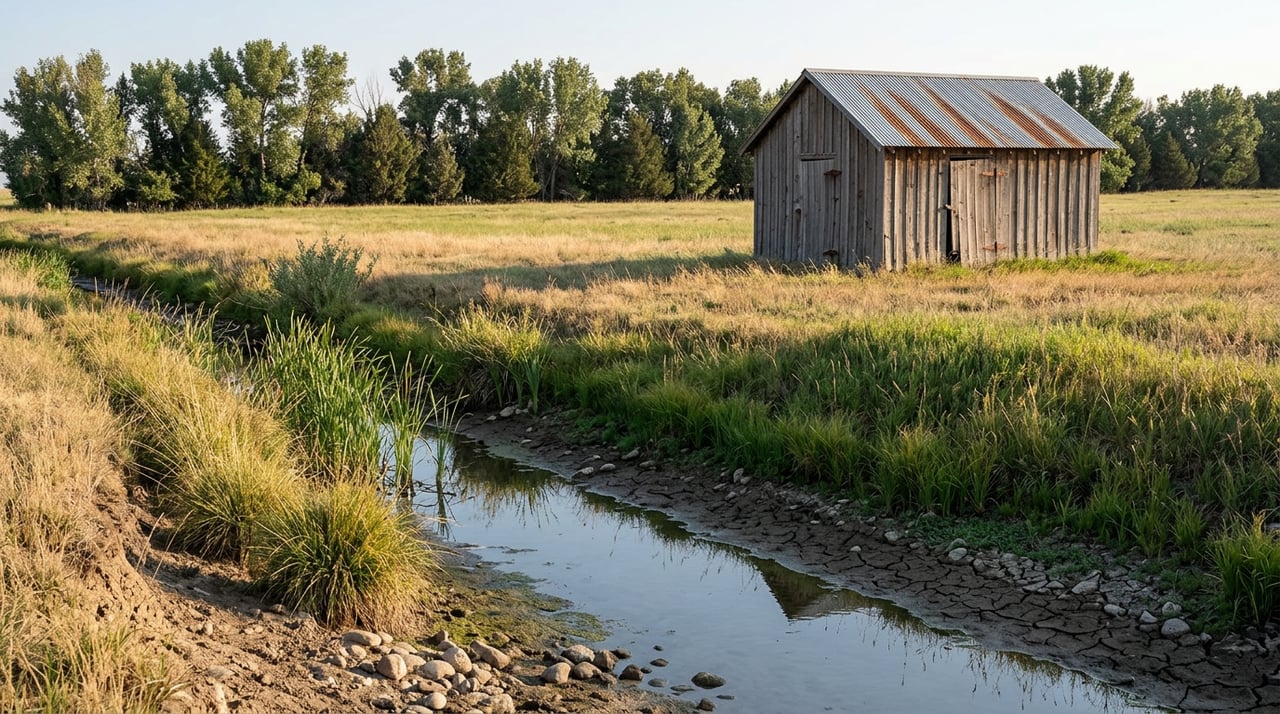
On August 13, Cowboy State Daily reported that the Powder River had dropped to near zero cubic feet per second at Locate, Montana, picking up only a trickle by the time it reached Moorhead, ten to twelve cubic feet per second. Records at the river's Arvada gauge, which date back to 1930, show the Powder has hit a standstill there only about a dozen times in nearly a century of measurement. In a typical year the river runs at 135 cfs at Arvada. By mid-June this year it had already fallen to 17.5 cfs.
The Powder River and the creeks that cross Banner-area acreage both start as snow on the same range, the east slope of the Bighorns, and both are administered by the same state water division out of Sheridan. The state's own snowpack tracking had flagged the shortfall coming back in March, when the water year measured the fourth-smallest snowpack recorded since 1936. Forecasters at the time still projected the Powder and Tongue basins would come in around 91 to 93 percent of median for the April-through-July runoff, a number that would have sounded like a mild, manageable shortfall. It did not hold for the Powder. That gap between a decent-looking March forecast and an August riverbed with no water in it is the whole story in miniature, and it is why a phrase on a listing sheet needs more scrutiny than most buyers give it.
Why the Listing Language Doesn't Tell You What You're Buying
Wyoming does not treat water the way most states do. Under Article 8 of the state constitution, the water in every stream, spring, and lake belongs to the state itself. Nobody owns water outright. What people own is a right to use a specific amount of it for a specific purpose, and that right is ranked against every other right on the same source by the date it was first put to beneficial use. The doctrine has a name: prior appropriation, or "first in time, first in right." A right established in 1885 outranks one established in 1985, permanently, regardless of who currently owns either property.
The state is split into four water divisions along those old river drainages, and the Bighorn foothills around Banner and Sheridan fall in Division 2, headquartered in Sheridan itself. That structure matters because it means every water right on your prospective property has a place in a specific priority line for that specific drainage, and that line is what determines whether water shows up during a year like this one.
In a shortage, senior right holders take their full allocation first. Junior rights wait, sometimes for nothing.
That single sentence is the entire mechanism a "water rights included" listing is glossing over. A right is not a guarantee. It is a position in a line, and this August is showing exactly what happens to the people standing at the back of it.
What Priority Date Actually Buys You
Rights established before Wyoming statehood in 1890 are called territorial rights, and they sit at the very front of nearly every priority list in the state. Everything after that is ranked by the date the state engineer's office approved the appropriation. A property advertised with irrigation rights, canal frontage, or a stock pond might carry a right dating to 1962 or one dating to 2004, and those two properties are not comparable investments in a drought year even if the acreage, the soil, and the asking price look identical on paper.
Here is the practical version of what that means when the water gets short:
| Right type | What happens when the source runs low |
|---|---|
| Senior right (early priority date) | Continues receiving its full decreed amount, water commissioners protect this call first |
| Junior right (recent priority date) | Curtailed or shut off entirely until senior demand upstream and downstream is satisfied |
| No documented right, just a well or ditch in use | No standing to call for water at all, regardless of how long it has been used |
The March forecast for the Powder and Tongue basins was not wrong so much as it was describing an average that a junior right holder never gets to experience. Averages smooth out the exact weeks when a stream drops to nothing, and those weeks are precisely when priority date stops being paperwork and starts being the water in your ditch or the absence of it.
The Verification Gap Nobody Selling You a Water Right Wants to Explain
Standard purchase contracts in Wyoming typically state that any water rights the seller owns will transfer to the buyer with the sale. That sentence is true and it tells you almost nothing. It does not say what right exists, what its priority date is, what volume it carries, or whether it has actually been used in the last five years, since a right left idle for five consecutive years can be subject to abandonment proceedings under state law.
Title insurance does not close this gap. A title policy confirms ownership, liens, and recorded encumbrances on the land itself. It does not verify or guarantee a water right, because water rights in Wyoming live in a separate record system administered by the State Engineer's Office, not in the county's real property records that a title company searches.
The verification burden sits entirely with the buyer. The State Engineer's e-Permit system lets anyone search by owner name or parcel to find permitted water rights, their priority dates, and their authorized uses, and the office will respond to direct inquiries when the online records raise more questions than they answer. If a property's water situation depends on a right that was never formally adjudicated, or on a well that predates current permitting, that history needs to surface before closing, not after.
If a buyer is weighing whether to supplement an existing right with a new domestic or stock well, the timeline is worth knowing upfront. Domestic and stock use permit applications typically process in one to two weeks through the State Engineer's Office, while more complex agricultural or commercial permits can take several months, and Statements of Completion currently carry a six-month to one-year backlog. None of that is fast enough to fix a water problem discovered during a thirty-day closing window.
What This Means If You're Comparing Two Listings This Fall
Two acreage listings near Banner can carry the identical phrase, water rights included, and be worth entirely different amounts depending on a priority date neither listing discloses. The number that matters is not whether a right exists. It is where that right sits in line for its drainage, and whether that drainage has water left to give by August.
Before making an offer on any property where irrigation, a stock pond, or canal frontage is part of the pitch, ask the seller for the permit number and priority date, then look it up directly rather than taking the listing's word for it. Ask how the water has actually been used in recent years, not just what the paperwork allows. And build the conversation with your lender or closing team around the fact that title insurance will not catch a gap here, so someone has to check it on purpose.
This is exactly the kind of detail that separates a smooth closing from a stressful one, and it is the sort of question worth raising early rather than during the option period. If you are comparing properties around Banner this fall and want a second set of eyes on what a listing's water language actually means for the parcel you are considering, Chad A Conley is ready to talk through it with you. Let's connect.